Campground Food Storage: Protect Wildlife and Follow Local Rules
Table of contents
- Quick answer
- Find the exact local rule
- Treat scented items as attractants
- Secure supplies on arrival
- Use only permitted storage methods
- Cook and clean without leaving rewards
- Do not assume a vehicle is approved storage
- Respond to wildlife and mistakes
- Food-storage checklist
- Frequently asked questions
- Sources and verification
- Conclusion
Quick answer
Before camping, read the current food-storage order for the exact campground and trail area. Store food, rubbish, coolers, cookware, pet food, toiletries, and other scented items immediately in the required locker, approved bear-resistant container, or other method named by the land manager. Never keep food in a tent. Keep meals within arm’s reach while in use, clean promptly, pack out scraps, and report wildlife that obtains food or enters camp.
Find the exact local rule
Food-storage rules vary by park, forest, campground, season, campsite type, and wildlife activity. One place may require a metal locker, another an approved hard-sided canister, and another may allow a specific hanging method. Vehicle storage may be permitted at one developed campground and prohibited at another. The National Park Service explicitly advises visitors to check the requirements for the park they will visit.
Use the managing agency’s official website, current permit, superintendent’s compendium, posted campground notice, or ranger instruction. Look for emergency closures and temporary wildlife orders shortly before travel and again at check-in. A blog, retailer chart, or memory from a prior trip does not override a current order.
Record the required container standard and the hours the rule applies. Wildlife can be active during daylight, so “overnight storage” is not always enough. Ask what must happen when everyone leaves for a hike, walks to the restroom, or turns away from the picnic table.
Treat scented items as attractants
The category is broader than food. NPS guidance lists drinks, rubbish, toiletries, soap, cosmetics, sunscreen, insect repellent, fuel, coolers, and items used to prepare or eat meals among scented things that may require secure storage. Sealed cans and unopened packages can still count. The rule is based on attraction, not on whether a person considers an item edible.
Include pet food and bowls, baby wipes, lip balm, toothpaste, medication with an odour, food wrappers, grease, fishing bait, game, and clothing with food spills when local rules identify them. Empty containers can retain residue. Keep a dedicated list on the lid of the storage bin so the group does not forget small items in pockets or tents.
Do not use fragrance to conceal food smell. It adds another attractant. Likewise, a cooler marketed as rugged or animal resistant is not necessarily approved by the land manager. Check the required certification or approved-products list.
Secure supplies on arrival
Make storage the first campsite job. Before pitching tents or exploring, place all regulated items in the approved locker, container, or designated system. NPS guidance advises securing food, rubbish, and scented items immediately on arrival. Leaving a full cooler unattended while setting up creates an opportunity for wildlife.
Inspect the provided locker. Make sure the latch closes and no rubbish, liquid, sharp object, or animal is inside. Do not use a damaged locker; report it and request instructions. Organise food into sealed bags or washable tubs within the locker to contain leaks and keep raw items separate.
Assign one adult to the final sweep after every meal and before leaving the site. Check the picnic table, fire ring, grill, ground, chair pockets, cup holders, vehicle interior, tent vestibule, and children’s bags. A single snack wrapper can undo an otherwise careful system.
Use only permitted storage methods
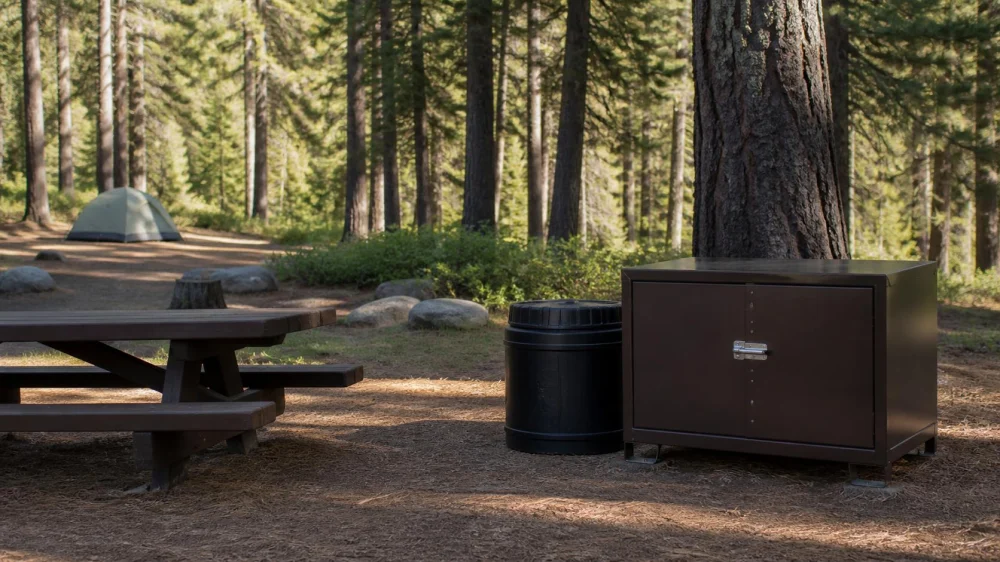
A campground locker is usually the simplest option when provided and required. Close and latch it after every use. Do not overfill it, leave scented items on top, or allow bags to block the door. Share fairly where lockers are communal and label food without exposing it outside.
For an approved bear-resistant food container, follow the manufacturer’s instructions and the land manager’s placement rule. Lock it whenever it is not actively in use. Store it on stable ground where it cannot roll into water, over a cliff, or near a tent. Do not attach ropes or items in a way that gives an animal leverage unless official instructions specifically direct it.
A food hang requires the right trees, distances, hardware, and skill, and is prohibited or impractical in many places. Never assume a generic “12 and 6” or other remembered formula is accepted. Use a hang only where the current local rule permits it and follow the stated measurements. Practise before the trip without damaging trees.
Cook and clean without leaving rewards
Use the designated cooking area or the separation directed by the campground. Keep food attended and within arm’s reach. Do not feed wildlife intentionally or allow animals to take scraps. A food reward can change animal behaviour and endanger later campers as well as the animal.
Prepare only what the group can manage. Catch scraps on a cleanable surface, strain food particles from wash water where rules require it, and dispose of water through the designated system. Do not dump grease, noodles, coffee grounds, or dishwater beside camp. Follow the site’s fire ring and rubbish rules; burning food or packaging is often incomplete and can attract wildlife.
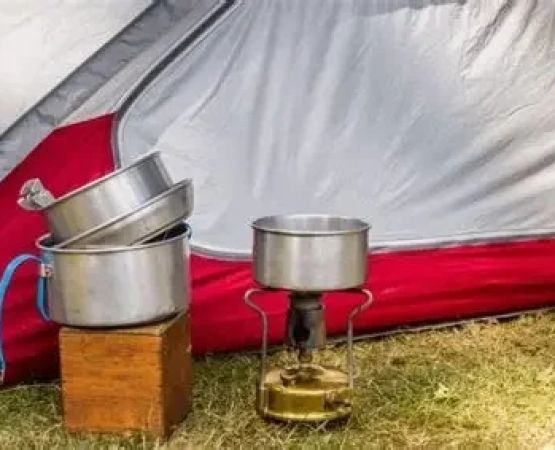
Wash cookware and wipe tables promptly. Store clean cookware, stoves, grills, and utensils as required because odours and residue remain. Pack rubbish and food scraps in sealed bags and place them in wildlife-resistant receptacles or carry them out.
Do not assume a vehicle is approved storage
NPS guidance warns that vehicle rules differ. Some parks allow daytime storage out of sight in a closed vehicle, while others require all food to be removed and placed in lockers. Pickup beds, roof baskets, exterior carriers, soft-top vehicles, and open windows may not qualify.
If vehicle storage is permitted, remove visible packages and clean crumbs, child seats, cup holders, and door pockets. Close windows completely and lock the vehicle according to local guidance. Never place food in a vehicle solely because a locker is inconvenient.
Heat creates a separate risk for food, pressurised containers, medicines, and pets. A locked vehicle that meets wildlife rules may still be unsafe for temperature-sensitive supplies. Plan both wildlife security and safe storage temperature.
Respond to wildlife and mistakes
If a bear or other large animal enters camp, follow the species- and park-specific instructions from the land manager. Do not approach, surround, feed, photograph at close range, or try to retrieve food from the animal. Move people to safety and contact a ranger or emergency service as directed.
Report any animal that obtains human food, damages storage, repeatedly approaches, or behaves aggressively. Include the campsite, time, species if known, attractant, and direction of travel. A report helps managers protect visitors and wildlife.
If you discover an unsecured item before wildlife reaches it, secure it immediately and redo the full campsite sweep. If a container or locker fails, do not improvise a weaker method; ask staff for an approved alternative or leave the area when safe compliance is impossible.
Food-storage checklist
- Current campground and backcountry storage orders
- Approved locker, canister, or permitted hanging equipment
- Capacity for all food, rubbish, toiletries, and scented gear
- Meal plan with minimal loose packaging
- Leak-resistant bags and rubbish bags
- Food-safe cold storage and thermometer when needed
- Group sweep assignment after every use
- Ranger and emergency contact information
- Backup plan if a locker is full or damaged
Frequently asked questions
Can I keep sealed food in my tent?
No. NPS guidance says not to store food in a tent or backpack. Packaging does not remove scent or meet local storage orders.
Do toiletries go in the food locker?
Often yes because they are scented. Check the local list and store toothpaste, soap, cosmetics, sunscreen, and similar items as directed.
Is a locked car always acceptable?
No. Some parks permit certain vehicle storage, while others require lockers or containers. Follow the exact local rule.
Can I hang food anywhere?
No. Hanging may be prohibited, ineffective, or impossible. Use it only where authorised and follow the required method.
What if an animal gets only a wrapper?
Report significant wildlife contact as directed and secure the site. Even small food rewards can reinforce animals’ approach to people.
Sources and verification
- U.S. National Park Service, Bear Safety: Storing Food — national overview of attractants, storage differences, camp use, and rubbish.
- NPS, Cooking in Camp — official camp-cooking and local-rule reminders.
- Denali National Park, Bear-Resistant Food Containers — example of a location-specific approval and requirement system.
These sources illustrate why local orders control. Verify the exact destination immediately before and during the trip.
Conclusion
Responsible food storage is a complete-camp habit. Learn the current rule, make enough room for every scented item, secure supplies on arrival, attend food while it is out, and clean before wildlife finds a reward. The method may change by destination, but the goal stays the same: protect people, property, and wild animals.