Camping in Bear Country: Store Food, Control Scents, and Protect Your Tent
Build a bear-country camp routine around local rules, secure storage, scented-item control, clean meals, locked containers, and prompt ranger reporting.
Camping in Bear Country: Store Food, Control Scents, and Protect Your Tent
Table of contents
Quick answer
Before arrival, read the exact park or forest food-storage order. Immediately secure food, rubbish, cookware, toiletries, pet food, and other scented items using the method required there—often a provided locker, an approved bear-resistant container, or an allowed hard-sided vehicle. Keep food within arm's reach while it is out, never store scented items in a tent, and close and latch the storage device every time. If a bear enters camp, prioritize people, follow site-specific instructions, and report the encounter to a ranger.
Start with local rules
There is no universal storage method or distance for every bear habitat. Some parks require lockers; some require an approved canister; some allow a hard-sided vehicle under defined conditions; and some prohibit food hangs. Regulations can differ between developed campgrounds and backcountry zones. Check the managing agency's current page, permit conditions, trailhead notices, and ranger instructions rather than relying on a rule remembered from another park.
Make the storage plan before packing. Confirm locker dimensions or approved-container requirements, learn how to operate the latch, and ensure every scented item will fit. A cooler by itself is not automatically bear resistant.
What counts as scented
Treat more than meals as attractants. Store snacks, unopened packages, drinks, rubbish, recycling, cooking grease, dishes, utensils, pet food and bowls, toiletries, toothpaste, soap, sunscreen, lip balm, insect repellent, medications, and scented wipes as local rules require. Clean crumbs from seats and bags. Do not keep a “small exception” in a sleeping bag or tent pocket.
Storage options
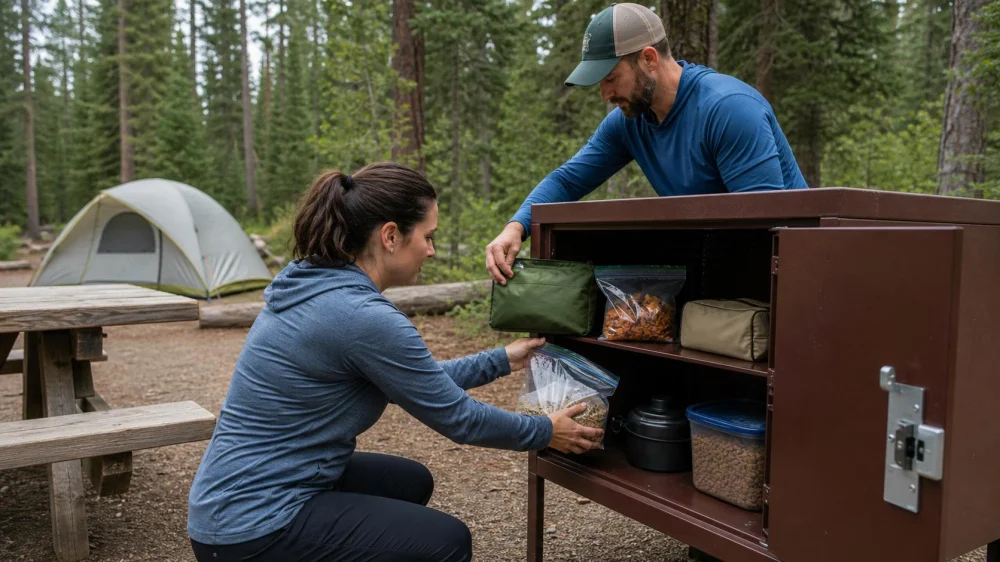
Provided food locker
Place all required items inside and latch it fully after every opening. Do not leave food on a picnic table while you step away.
Bear-resistant container
Use a model approved for that area, pack it correctly, and keep it closed and locked even when camp is occupied. Store it on stable ground where a bear cannot roll it over a cliff or into water; follow the local distance requirement.
Hard-sided vehicle
Use a vehicle only where the local order permits it. Close windows and doors, keep food out of sight if required, and never use an open truck bed. Soft-sided campers and tents are not substitutes for secure storage.
Food hang
Hang food only when expressly allowed and only to the agency's dimensions. In some high-use areas, hanging is illegal or ineffective and an approved canister is mandatory.
Camp routine
- Secure all attractants immediately after reaching the site.
- Take out only what is needed for the current meal and keep it within arm's reach.
- Cook and eat in the designated area or at the locally recommended distance from sleep space.
- Collect scraps, wipe the table, wash up as directed, and secure rubbish promptly.
- Relatch lockers and containers after every use; verify them before a walk and before sleep.
- Do a final tent-pocket, vehicle-seat, and picnic-table sweep.
If a bear appears
Bear behavior and recommended responses vary by species, setting, and behavior. Do not run toward or approach a bear for a photograph, do not feed it, and do not attempt to retrieve food at the expense of personal safety. Move to a safe place and use the specific instructions supplied by that park. Report a bear that enters camp, obtains human food, damages property, or behaves aggressively to a ranger as soon as possible; call 911 for an immediate threat where service is available.
Checklist
- Current area-specific food order saved offline.
- Approved storage method confirmed and large enough.
- Food, rubbish, cookware, toiletries, medication, and pet supplies included.
- No scented item planned for the tent.
- Cooking, sleeping, and storage layout follows local distances.
- Every adult knows how to latch the locker or container.
- Ranger and emergency contact details recorded.
Limitations
This guide cannot identify the correct response for every black-bear, grizzly-bear, or polar-bear encounter. Distances, approved containers, vehicle rules, bear-spray regulations, and encounter procedures differ by location and can change. Official site instructions, permits, closures, and ranger directions always control. Seek qualified trip planning for remote travel.
FAQ
Can toiletries stay in my tent?
No. Treat toiletries and other scented products like food and store them as the local rule directs.
Is a locked cooler enough?
Not necessarily. Use only storage specifically accepted for the area; many ordinary coolers are not bear resistant.
Can I leave food out while I am nearby?
Keep it within arm's reach and actively attended. Secure it whenever it is not in immediate use.
Should I use a food hang everywhere?
No. Some areas prohibit hangs or require canisters. Check the exact regulation before the trip.
Evidence notes
The National Park Service advises campers to secure food, garbage, and scented items on arrival; keep food attended; and never store food in a tent. Because allowed methods vary by park, consult both the NPS overview on bear-safe food storage and the current rules for the exact unit and campsite.
Conclusion
A clean camp is a repeatable system, not a one-time tidy-up. Know the local order, include every scented item, keep food attended, relatch storage immediately, and keep attractants out of the tent. Those habits protect campers and help prevent bears from learning that campsites provide food.
More
How to Choose the Right Tent Size for Your Group
Jul 15, 2026Learn how to choose the right tent size for your group with practical camping tips covering capacity, comfort, weather conditions, gear storage, and group camping needs.
How to Camp Comfortably in a Small Car Without Feeling Cramped or Disorganized
Jul 05, 2026Learn how to camp comfortably in a small car without feeling cramped or disorganized, with smart space-saving tips, gear strategies, real camping stories, and practical setup advice.
18 Camping Tips to Pack Light and Travel More Efficiently
Jul 02, 2026Discover 18 camping tips that help you pack light and travel more efficiently, with real camping stories, gear strategies, and practical outdoor packing advice.

25 Best Campgrounds in the US for Every Outdoor Experience
Jun 29, 2026Discover 25 Best Campgrounds in the US That Offer the Perfect Outdoor Experience for All Levels, from beginner-friendly sites to advanced wilderness escapes, with tips, stories, and planning advice for unforgettable camping trips.
How to Camp Comfortably Without Electricity: Practical Off-Grid Guide
Jun 27, 2026Learn how to camp comfortably without electricity using practical off-grid strategies, gear choices, and real camping experiences. Discover how Camping With Kayla helps you enjoy modern comfort in nature.
22 Camping Hacks That Will Change Your Outdoor Experience
Jun 24, 2026Discover 22 camping hacks that will completely change your outdoor experience with practical tips, real-life camping stories, and expert advice for comfort, safety, and efficiency.