Campsite Arrival Checklist: Inspect Before You Unpack
Inspect a campsite before unpacking with a practical checklist for tree hazards, drainage, weather, fire rules, food storage, layout, and emergencies.
Campsite Arrival Checklist: Inspect Before You Unpack
On this page
- Quick answer
- Check in and read current alerts
- Look up for tree hazards
- Check drainage and weather exposure
- Plan sleeping, cooking, and traffic zones
- Verify fire rules before lighting
- Secure food and scented items
- Finish essential setup before dark
- When to reject or leave a site
- Limitations and emergency notes
- Frequently asked questions
- Sources and evidence notes
- Conclusion and next steps
Quick answer
Before unpacking, confirm the assigned site and current ranger or host alerts, then inspect overhead branches, leaning or damaged trees, drainage channels, low ground, rockfall, wind exposure, fire restrictions, wildlife signs, and escape routes. Place the tent on durable level ground away from hazards, cooking, and fire. Keep food and scented items in the campground-required storage, and finish essential setup before dark.
A campsite hazard check is a deliberate walk-through that identifies changing environmental, fire, wildlife, access, and layout risks before people and equipment occupy the site.
Check in and read current alerts
- Confirm the site number, boundary, vehicle limit, occupancy, permit, and checkout time.
- Ask about severe weather, flash flooding, wildlife activity, tree hazards, fire restrictions, air quality, closures, and water availability.
- Locate the host or ranger, emergency phone or call box, evacuation route, shelter, restroom, and potable-water source.
- Download or photograph rules and maps when service is available.
- Tell the group the site name, number, road, and nearest emergency landmark.
Conditions can change after booking. A reservation does not guarantee that a fire, trail, water system, or particular campsite feature remains available.
Look up for tree hazards
Walk the tent, parking, cooking, and seating areas while looking up and around. Avoid dead branches overhead, visibly damaged or leaning trees, hanging limbs, cracked trunks, root failure, and trees affected by fire, insects, disease, or recent storms. Healthy-looking trees can also shed limbs.
Do not cut, move, or “fix” a standing hazard yourself. Contact the host or ranger and request assessment or reassignment. Increase caution during wind, rain, snow load, and after wildfire.
Check drainage and weather exposure
- Avoid washes, ravines, dry creek beds, flood debris, and low depressions.
- Look for mud lines, piled branches, scoured soil, and channels showing previous flow.
- Choose level ground that is not the lowest point.
- Avoid exposed peaks, isolated open areas, cliff edges, and rockfall zones.
- Identify a substantial building or hard-topped vehicle for lightning shelter when available; a tent is not lightning protection.
- Check forecast and alerts beyond the immediate campsite because flooding can begin from distant storms.
Plan sleeping, cooking, and traffic zones
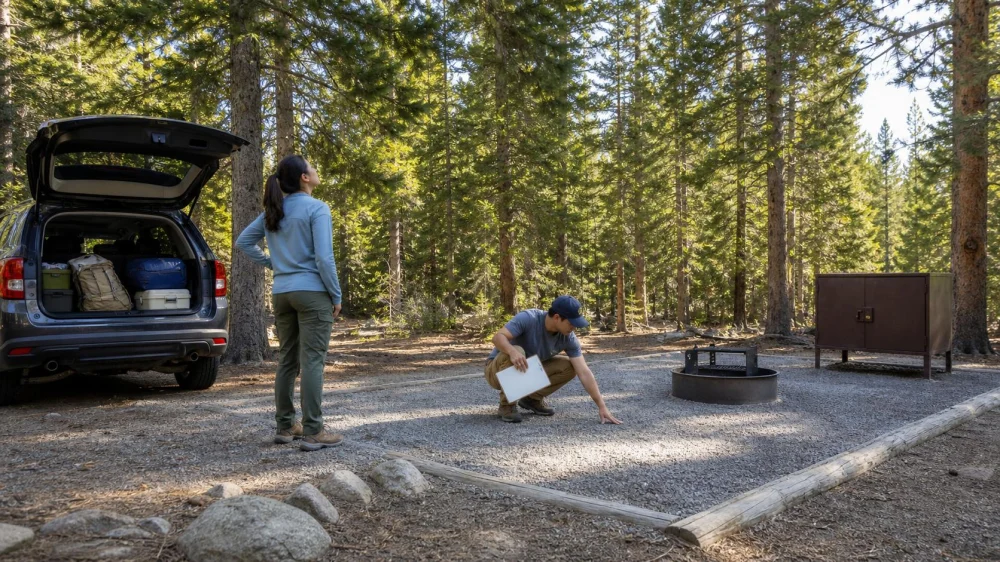
Use the established tent pad, parking spur, fire ring, and durable surfaces. Keep the tent a safe distance from fire and cooking areas, following site-specific food-storage rules. In bear country, required distances and storage methods may be much greater.
Keep guy lines away from the main route or mark them visibly. Preserve a clear path between tent, vehicle, restroom, and exit. Do not dig drainage trenches, move vegetation, attach lines to trees where prohibited, or expand the campsite beyond its boundary.
Verify fire rules before lighting
- Check the current restriction for that campground and day.
- Use only permitted devices and established rings or grills.
- Clear tents and flammable gear by the required distance and consider wind direction.
- Keep water and tools immediately available.
- Never leave a fire unattended.
- Extinguish it completely before sleep or departure according to local instructions.
A fire ring does not mean fires are currently permitted. During restrictions, wood, charcoal, certain stoves, or all flames may be prohibited. Use locally allowed firewood to reduce pest movement.
Secure food and scented items
Follow the exact campground rule for lockers, hard-sided vehicles, approved canisters, hanging, trash, coolers, cooking clothes, pet food, toiletries, and dishwater. Never feed wildlife. Keep the site clean and do not store food in a tent.
Wildlife rules vary by species and location. Ask staff about recent activity and what to do during an encounter. Do not approach an animal for a photo or block its escape.
Finish essential setup before dark
- Pitch and stake the tent according to manufacturer directions.
- Prepare rain protection and secure loose gear.
- Set up legal food storage before cooking.
- Place headlamps, first aid, warm layers, water, and keys where everyone can find them.
- Walk the restroom and vehicle route in daylight.
- Review weather, quiet hours, and an overnight evacuation plan.
If arriving after dark, minimize activity, use established surfaces, and postpone nonessential setup. Never accept an unseen hazardous location just to avoid asking for help.
When to reject or leave a site
Ask for another site or leave when a material hazard cannot be controlled: unstable trees or branches, active flooding or rising water, rockfall, wildfire or evacuation order, severe lightning exposure without shelter, dangerous wildlife activity, damaged electrical hookups, or a site outside permitted boundaries.
Do not wait for visible water when an official flash-flood warning or evacuation order applies. Follow ranger, emergency-management, and campground instructions.
Limitations and emergency notes
This is general outdoor-safety guidance, not a professional tree, weather, fire, wildlife, or medical assessment. Frontcountry and backcountry rules differ, and each public land unit, private campground, season, and permit may impose specific requirements.
For immediate danger, move to the safest available location and contact 911 or the land manager's emergency dispatch as appropriate. Satellite communicators and phones can fail; share a trip plan before departure.
Frequently asked questions
Is a designated campsite automatically hazard-free?
No. Weather, trees, flooding, fire, and equipment conditions change. Inspect it and report concerns.
Can I pitch in a low spot if the forecast is dry?
Avoid depressions and drainage routes. Distant storms and unexpected rain can create water flow.
Does a fire ring mean I can have a fire?
No. Check current restrictions and allowed fuel or devices each day.
What if a dead branch is above the tent pad?
Do not camp beneath it or remove it yourself. Contact the host or ranger for assessment or reassignment.
Should food stay in the car?
Only when local rules permit and the vehicle meets the required storage method. Follow the campground's exact instructions.
Sources and evidence notes
The National Park Service advises checking for flash floods, lightning, wind, dead trees and branches, avoiding low ground and ravines, separating sleeping and cooking areas, and setting up before dark in its guide to finding and setting up a campsite. NPS also recommends checking current alerts with rangers or hosts in its camping safety guidance.
Conclusion and next steps
Save this checklist offline and use Camping With Kayla to discover potential destinations, then open the official land-manager page for permits, alerts, food storage, fire rules, and emergency contacts. At arrival, walk the entire site before opening a gear bin. Ten careful minutes can reveal the hazard that a booking photo never showed.
More
How to Choose the Right Tent Size for Your Group
Jul 15, 2026Learn how to choose the right tent size for your group with practical camping tips covering capacity, comfort, weather conditions, gear storage, and group camping needs.
How to Camp Comfortably in a Small Car Without Feeling Cramped or Disorganized
Jul 05, 2026Learn how to camp comfortably in a small car without feeling cramped or disorganized, with smart space-saving tips, gear strategies, real camping stories, and practical setup advice.
18 Camping Tips to Pack Light and Travel More Efficiently
Jul 02, 2026Discover 18 camping tips that help you pack light and travel more efficiently, with real camping stories, gear strategies, and practical outdoor packing advice.

25 Best Campgrounds in the US for Every Outdoor Experience
Jun 29, 2026Discover 25 Best Campgrounds in the US That Offer the Perfect Outdoor Experience for All Levels, from beginner-friendly sites to advanced wilderness escapes, with tips, stories, and planning advice for unforgettable camping trips.
How to Camp Comfortably Without Electricity: Practical Off-Grid Guide
Jun 27, 2026Learn how to camp comfortably without electricity using practical off-grid strategies, gear choices, and real camping experiences. Discover how Camping With Kayla helps you enjoy modern comfort in nature.
22 Camping Hacks That Will Change Your Outdoor Experience
Jun 24, 2026Discover 22 camping hacks that will completely change your outdoor experience with practical tips, real-life camping stories, and expert advice for comfort, safety, and efficiency.