
Campsite Gray Water Disposal: Check Rules Before Washing
Dispose of campsite gray water correctly: check local rules, strain dishwater, use designated facilities, follow backcountry directions, and keep RV tanks closed.
Campsite Gray Water Disposal: Check Rules Before Washing
On this page
- Quick answer
- Know what counts as gray water
- Check the exact campground rule
- Reduce wastewater before creating it
- Set up a controlled dishwashing station
- Strain food and pack scraps out
- Use the designated disposal method
- Follow backcountry directions
- Keep RV gray tanks closed
- Respond to spills and full containers
- Gray-water checklist
- Official campground sources
- Conclusion and next steps
Quick answer
Before washing at camp, read the current campground or land-manager rules for gray water. Developed sites may require every drop in a sanitary sink, toilet, sump, or dump station and prohibit ground disposal. Some backcountry areas instead direct campers to carry water 200 feet from water, trails, and camps, use little biodegradable soap, strain food scraps, pack them out, and scatter the liquid. Never wash at a drinking-water spigot or dump an RV tank on the ground.
Rules differ because soil, wildlife, crowding, plumbing, and water protection differ. Follow the rule for the exact site rather than a universal camping shortcut.
Know what counts as gray water
Gray water is used water that does not contain toilet waste. At camp it can include dishwater, handwashing water, shower water, laundry water, melted cooler ice contaminated by food, and RV sink or shower effluent.
It can still contain food particles, grease, soap, microbes, sunscreen, toothpaste, and odors that attract wildlife or affect water quality.
Black water contains human waste and always requires the approved toilet or sewage-disposal system. Never combine improvised disposal methods.
Check the exact campground rule
Read the reservation page, entrance board, campsite notice, permit, and current superintendent or forest order. Ask a ranger or host when wording is unclear.
A developed campground can require a sanitary sink or dump station even when backcountry guidance elsewhere says to scatter strained dishwater.
Seasonal drought, wildlife, frozen plumbing, fire, or public-health conditions can change normal facilities and rules.
Reduce wastewater before creating it
Plan simple meals, portion ingredients, and scrape cookware before food dries. Use a spatula or small piece of paper towel to remove grease and pack it out.
Heat only the water needed and use a small basin rather than running a spigot. Do not put soap, dishes, hands, or hoses against potable-water outlets.
Use soap only when needed and choose a small amount. “Biodegradable” does not mean safe to dump beside a stream or campsite.
Set up a controlled dishwashing station
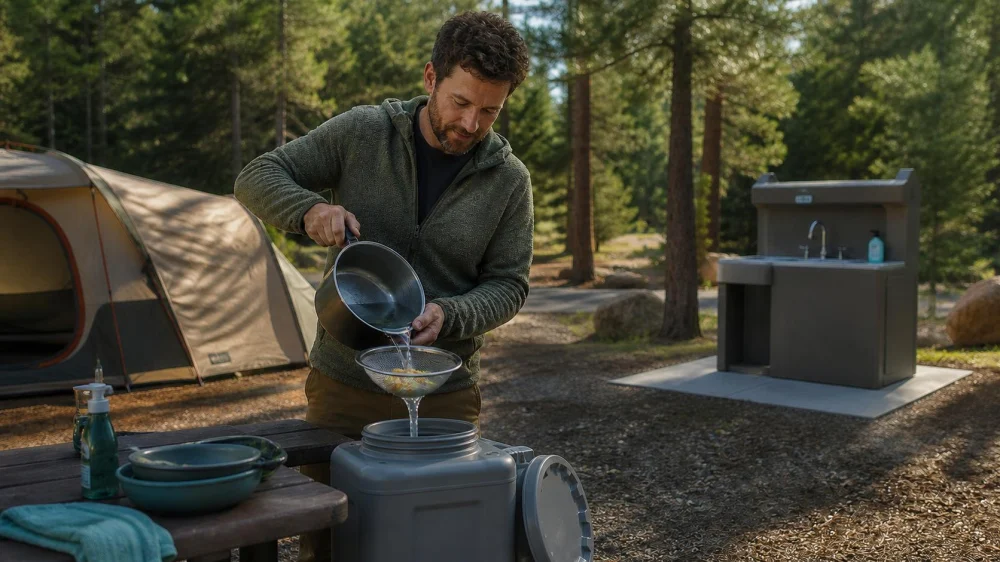
Use separate wash, rinse, and sanitising steps appropriate for the food and local guidance. Keep basins stable and away from tent doors, children, pets, and foot traffic.
Carry water from the source in a clean container rather than washing at the faucet. Prevent dirty utensils from touching picnic-table food-preparation areas.
Collect all wastewater in one container with a secure lid or pour spout so it can reach the approved disposal point.
Strain food and pack scraps out
Pour dishwater through a fine strainer that captures rice, noodles, crumbs, grounds, and other particles. Put the solids in secured rubbish.
Do not bury, burn, or scatter food scraps. Even tiny pieces can attract insects, rodents, birds, bears, and other wildlife.
Clean the strainer into the rubbish bag and store it with food-scented items according to local wildlife rules.
Use the designated disposal method
At a developed campground, use only the marked gray-water sink, toilet, sump, drain, or dump station specified by the operator. Never pour into a storm drain or onto vegetation unless explicitly directed.
Carry the container with its lid secured and avoid transporting heavy hot water. Make several trips rather than risk a spill.
Leave the disposal fixture clean and follow any posted restriction on solids, chemicals, or RV hoses.
Follow backcountry directions
Where the land manager specifically permits scattering, move the required distance from water, camps, trails, and sensitive vegetation. Two hundred feet is common but not universal.
Strain the water first and broadcast it over a wide durable area rather than pouring one puddle. Avoid animal burrows, cryptobiotic soil, and saturated ground.
In arid, alpine, heavily used, or regulated areas, packing gray water out may be required. The permit controls.
Keep RV gray tanks closed
Use a legal dump station or sewer connection and keep valves closed except during an approved transfer. Ground discharge can violate campground and land-management rules.
Check tank capacity before arrival, monitor levels, and conserve water. Carry compatible hoses, fittings, gloves, and a sealed storage container.
Do not use a potable-water hose for sewage or gray-water handling. Follow station instructions and wash hands afterward.
Respond to spills and full containers
Stop the source, keep people away from a slippery area, and collect solids. Notify the host or ranger when a large spill reaches a road, drain, water source, or neighbouring site.
If the designated facility is closed or full, do not improvise. Ask for another approved location or store wastewater securely until it can be transported.
For chemical, sewage, or fuel contamination, follow emergency and hazardous-waste directions rather than ordinary gray-water guidance.
Gray-water checklist
- Current site and permit rules checked
- Designated sink, sump, toilet, or dump station located
- Wash basins, fine strainer, and lidded container packed
- Food and grease scraped into secured rubbish
- Water and soap use minimised
- Spigot protected from washing and hose contamination
- Backcountry distance and scattering rule verified
- RV tank capacity and legal dump plan confirmed
Official campground sources
Point Reyes National Seashore directs backcountry campers to carry wash water 200 feet away, use little soap, strain scraps, pack them out, and scatter liquid; see its camping guidance.
Other NPS sites require all liquid waste at a sanitary station, showing why local rules control; see Mesquite Spring Campground rules.
The U.S. Forest Service explains that campgrounds usually have designated disposal areas and gives separate backcountry advice in its dispersed camping guide.
Conclusion and next steps
Gray water is still waste, and the correct disposal method changes by place. Check the exact rule, reduce water and food residue, collect every drop, and use the designated facility. Only scatter strained water when the land manager expressly directs it, at the required distance and over a wide area. A planned container and disposal route protect wildlife, water, neighbours, and your campsite.
More
How to Choose the Right Tent Size for Your Group
Jul 15, 2026Learn how to choose the right tent size for your group with practical camping tips covering capacity, comfort, weather conditions, gear storage, and group camping needs.
How to Camp Comfortably in a Small Car Without Feeling Cramped or Disorganized
Jul 05, 2026Learn how to camp comfortably in a small car without feeling cramped or disorganized, with smart space-saving tips, gear strategies, real camping stories, and practical setup advice.
18 Camping Tips to Pack Light and Travel More Efficiently
Jul 02, 2026Discover 18 camping tips that help you pack light and travel more efficiently, with real camping stories, gear strategies, and practical outdoor packing advice.

25 Best Campgrounds in the US for Every Outdoor Experience
Jun 29, 2026Discover 25 Best Campgrounds in the US That Offer the Perfect Outdoor Experience for All Levels, from beginner-friendly sites to advanced wilderness escapes, with tips, stories, and planning advice for unforgettable camping trips.
How to Camp Comfortably Without Electricity: Practical Off-Grid Guide
Jun 27, 2026Learn how to camp comfortably without electricity using practical off-grid strategies, gear choices, and real camping experiences. Discover how Camping With Kayla helps you enjoy modern comfort in nature.
22 Camping Hacks That Will Change Your Outdoor Experience
Jun 24, 2026Discover 22 camping hacks that will completely change your outdoor experience with practical tips, real-life camping stories, and expert advice for comfort, safety, and efficiency.