
Look Up Before You Pitch: Campsite Tree Hazard Checks
Inspect trees and overhead branches before pitching a tent, recognise warning signs, recheck after weather changes, and know when to relocate.
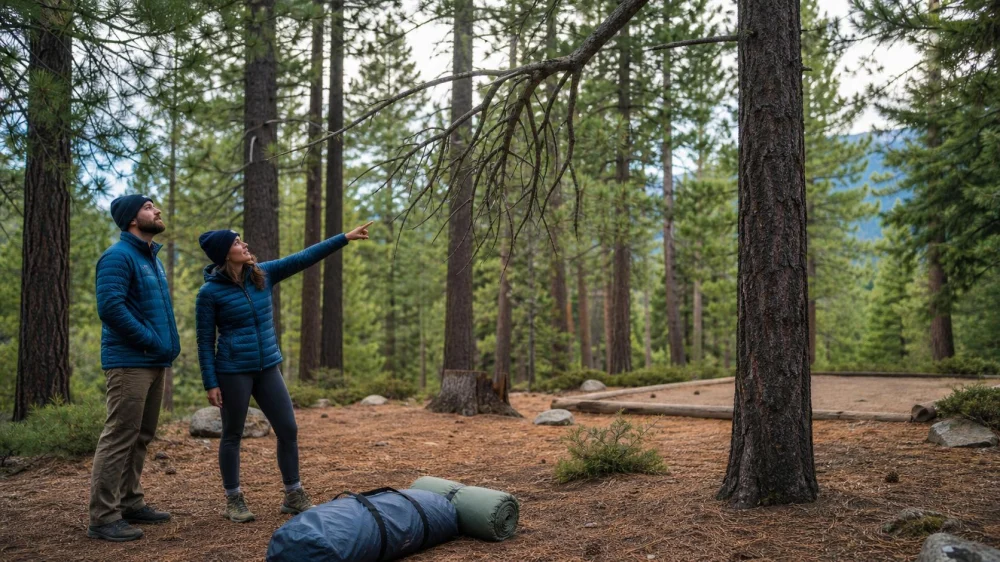
Look Up Before You Pitch: Campsite Tree Hazard Checks
On this page
Quick answer
Before pitching a tent, look up and around for dead limbs, split trunks, hanging branches, leaning trees, damaged roots, recent fire or insect damage, and trees that could reach the sleeping area if they fall. Check again after wind, heavy rain, snow, or fire. Do not cut, move, or attach gear to questionable trees; relocate and report the concern to campground staff or the land manager.
A tree hazard is a tree or branch with a defect and a potential target—such as a tent, picnic table, vehicle, or path—that could be struck if it fails.
A campsite inspection
- Walk the full site boundary before unloading.
- Look straight up above the tent pad, table, hammock area, and parking space.
- Scan nearby trunks from base to crown and from more than one angle.
- Estimate the fall zone of leaning or dead trees, including beyond the marked pad.
- Check the ground for fresh branches, lifted roots, cracks, saturated soil, and erosion.
- Notice evidence of fire, lightning, disease, decay, or insect damage.
- Choose another approved spot or contact staff if uncertain.
Warning signs to notice
- Large dead branches, broken tops, or limbs suspended in the canopy.
- A trunk with major cracks, cavities, splits, or fresh exposed wood.
- A tree leaning toward the campsite with newly disturbed soil or roots.
- Dead standing trees within falling distance.
- Fire-scarred, recently burned, drought-stressed, or beetle-damaged stands.
- Mushrooms or extensive decay at the base, especially with other defects.
- Fresh debris after wind, rain, or snow.
One visual clue does not prove imminent failure, and a healthy-looking tree can still shed a limb. The goal is conservative site choice, not amateur diagnosis.
Recheck when weather changes
Wind, saturated ground, snow load, freeze-thaw cycles, and wildfire can change risk quickly. Follow closures and warnings, and move to a safer designated location if branches begin falling, trees sway abnormally, roots move, or officials advise evacuation.
Never stay in a tent during severe wind solely because it is already set up. A vehicle or building may reduce some falling-debris exposure, but choose its location carefully and follow local emergency direction.
What to do about a concern
At a developed campground: leave the area beneath the tree, note the site number, and contact the host, ranger, or office. Request another site rather than modifying vegetation.
In dispersed or backcountry camping: move outside the potential fall zone while remaining within legal camping boundaries and surface-use rules. Avoid creating a new impact area when a safer durable site exists.
Do not shake limbs, climb the tree, cut branches, drive nails, or hang a hammock from a damaged tree. Professional assessment and tree work require training and equipment.
Limitations and important notes
No visual check makes a wooded campsite risk-free. Trees and branches can fall without obvious warning or wind. Park staff may close areas because of hazards not visible to visitors.
Rules about site relocation, hammocks, vegetation, and fire-damaged areas differ by land manager. Follow posted rules, permits, and ranger instructions.
Frequently asked questions
Is a dead tree safe if there is no wind?
No assumption of safety is justified. The National Park Service notes that trees and branches can fall even without wind.
Can I pitch under a healthy tree for shade?
Shade can be useful, but inspect the entire crown and surrounding fall zones first. Avoid obvious defects and follow designated-pad rules.
Should I move a fallen branch myself?
Small ground debris may be handled only if site rules allow and it is clearly safe. Never handle suspended, tensioned, heavy, or storm-damaged limbs; report them.
Can I attach a hammock to any two trees?
No. Confirm that hammocks are permitted and use only suitable, healthy trees with approved protective straps.
Sources and evidence notes
This guide follows National Park Service camping guidance to look for dead branches overhead, avoid dead trees and other falling hazards, consider wind and weather, and use established campsite and land-manager instructions.
Next steps
Before unpacking, walk the site, look up from every occupied area, and reconsider the fall zone after weather changes. If a tree raises doubt, move people away and ask the land manager for a safer option.
More
How to Choose the Right Tent Size for Your Group
Jul 15, 2026Learn how to choose the right tent size for your group with practical camping tips covering capacity, comfort, weather conditions, gear storage, and group camping needs.
How to Camp Comfortably in a Small Car Without Feeling Cramped or Disorganized
Jul 05, 2026Learn how to camp comfortably in a small car without feeling cramped or disorganized, with smart space-saving tips, gear strategies, real camping stories, and practical setup advice.
18 Camping Tips to Pack Light and Travel More Efficiently
Jul 02, 2026Discover 18 camping tips that help you pack light and travel more efficiently, with real camping stories, gear strategies, and practical outdoor packing advice.

25 Best Campgrounds in the US for Every Outdoor Experience
Jun 29, 2026Discover 25 Best Campgrounds in the US That Offer the Perfect Outdoor Experience for All Levels, from beginner-friendly sites to advanced wilderness escapes, with tips, stories, and planning advice for unforgettable camping trips.
How to Camp Comfortably Without Electricity: Practical Off-Grid Guide
Jun 27, 2026Learn how to camp comfortably without electricity using practical off-grid strategies, gear choices, and real camping experiences. Discover how Camping With Kayla helps you enjoy modern comfort in nature.
22 Camping Hacks That Will Change Your Outdoor Experience
Jun 24, 2026Discover 22 camping hacks that will completely change your outdoor experience with practical tips, real-life camping stories, and expert advice for comfort, safety, and efficiency.