
Wildfire Near Camp? Leave Early and Follow Official Evacuation Orders
Prepare multiple campsite exits, recognise wildfire warnings, leave immediately when directed, protect the group during smoke, and wait for an official return.
Wildfire Near Camp? Leave Early and Follow Official Evacuation Orders
On this page
- Quick answer
- Check fire conditions before the trip
- Map more than one exit
- Recognise warnings without waiting for flames
- Leave immediately when directed
- Take people, essentials, and a ready vehicle
- Reduce smoke exposure during evacuation
- Act if your route is blocked
- Do not return until authorities say it is safe
- Improve the next wildfire plan
Quick answer
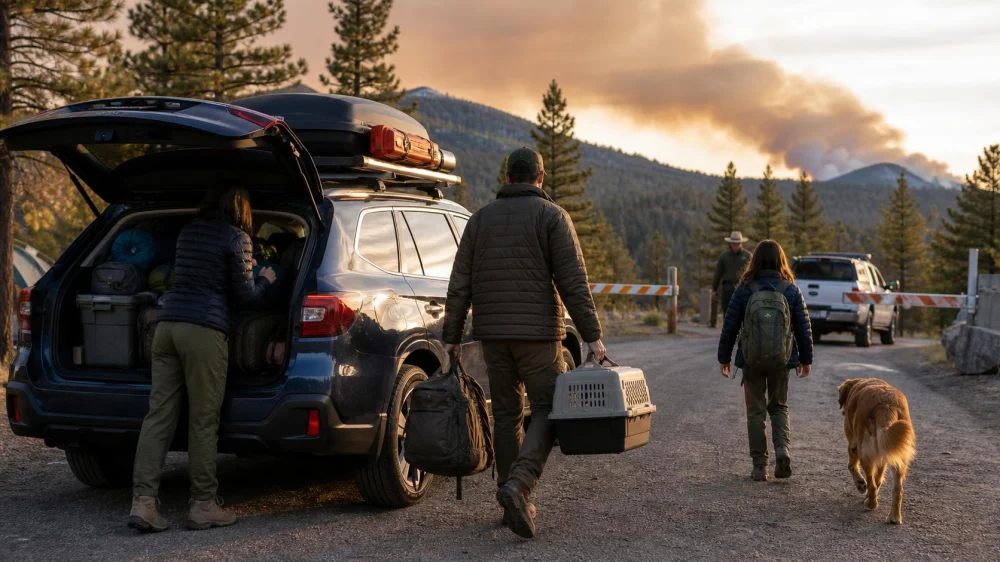
If wildfire, fast-moving smoke, falling ash, or an evacuation notice threatens your campsite, leave early using the route directed by authorities. Wake everyone, account for children and pets, put on sturdy shoes, take phones, medications, identification, water, and the already-packed emergency bag, and go. Do not delay to dismantle camp, photograph flames, wait for a better view, or retrieve replaceable gear.
Call 911 for immediate danger and give your campsite, campground, road, direction of smoke, group size, vehicles, and mobility or medical needs. Follow ranger, sheriff, fire, emergency-alert, and road-control instructions. Never drive around a closure or through visible flame, dense smoke, downed lines, or falling trees.
Check fire conditions before the trip
Before leaving home, check the land manager’s alerts, campground notices, local emergency management, weather, fire restrictions, active incidents, air quality, and road closures. Conditions can change after booking, so check again on departure day and at the ranger station or campground entrance.
Know whether fires, charcoal, stoves, generators, or smoking are restricted. A legal fire can become unsafe as wind and restrictions change. If conditions are severe or evacuation options are limited, postpone or relocate instead of relying on last-minute escape.
Map more than one exit
Mark the campground loop, numbered site, nearest staffed location, primary exit, alternate road, turnaround points, water crossings, gates, and places where large vehicles cannot pass. Download maps for offline use and carry paper backup. Do not assume the road used to enter will remain open.
Tell the group where to meet if separated and designate drivers. Keep the vehicle facing out when permitted, with keys controlled, adequate fuel or charge, and nothing blocking departure. Ask rangers about routes suitable for trailers, RVs, mobility devices, and current construction.
Recognise warnings without waiting for flames
Official alerts, sirens, ranger contact, aircraft, road closures, sudden smoke growth, an orange sky, ash, embers, unusual fire behaviour, and rapidly changing wind all require attention. Smoke may hide distance and direction; a quiet campsite can still be threatened.
Do not treat lack of mobile service as proof there is no warning. Use a weather radio or other permitted alert method, check posted notices, and speak with campground staff. If you see an unattended fire or new smoke column, report it from a safe location with coordinates or landmarks.
Leave immediately when directed
Ready.gov wildfire guidance says to leave immediately when authorities direct evacuation. Follow the named route even if a navigation app suggests another. Emergency crews may route traffic away from fire, smoke, damaged roads, or incoming equipment.
Do not wait for every group member to agree or for a mandatory order if officials advise early departure. If you can leave safely before traffic builds, do so. Tell staff you have departed when their checkout system requests it, but never delay evacuation for routine paperwork.
Take people, essentials, and a ready vehicle
Priorities are people, service animals and pets, critical medication and devices, identification, phones and power, keys, water, protective clothing, and the emergency bag. Use carriers and leashes before opening the tent or vehicle. Count everyone by name.
Leave tents, chairs, coolers, and other gear if packing would delay departure. Close fuel containers and turn off equipment only when it takes seconds and is safe. Do not attach a trailer under evacuation pressure if the vehicle can leave faster without it and authorities have not directed otherwise.
Reduce smoke exposure during evacuation
Keep vehicle windows and vents closed and use recirculated air when smoke is outside. A well-fitting N95 respirator can reduce exposure to smoke particles when properly worn, but it does not supply oxygen or protect against every fire gas. Children and people with heart or lung conditions need extra caution.
Move toward cleaner air and the official shelter or destination. Do not stop on the shoulder unless directed; stalled vehicles can block emergency access. Seek urgent medical help for severe breathing difficulty, chest pain, confusion, fainting, or other emergency symptoms.
Act if your route is blocked
Turn around before entering dense smoke, flame, falling debris, flooded crossings, or downed power lines. Do not abandon a vehicle in a travel lane. Contact 911, provide precise location and conditions, and follow dispatcher instructions; emergency response may be delayed.
If officials direct you to a temporary refuge, shelter, or specific cleared area, go there. Do not invent a route through vegetation or hike away unless authorities instruct it or remaining creates a more immediate danger. Keep lights on as directed and make your location visible to responders.
Do not return until authorities say it is safe
A passed flame front does not make the area safe. Roads, trees, bridges, utilities, water systems, and slopes may be damaged; ash pits and smouldering roots can remain hot. Wait for the land manager or emergency authority to reopen the area.
When return is allowed, wear sturdy footwear and avoid ash, charred trees, hot ground, damaged propane containers, and downed wires. Photograph losses from a safe location, follow instructions for food and water, and report hazards instead of moving them.
Improve the next wildfire plan
Afterward, record which alerts arrived, how long departure took, what gear slowed the group, and whether maps, fuel, carriers, medication, and communication worked. Replace used supplies and update contact and medical information.
For the next trip, keep one grab bag packed, park for departure, maintain multiple route options, and set clear “leave now” triggers before emotions and smoke make decisions harder. Early movement is the central safety advantage.
More
How to Choose the Right Tent Size for Your Group
Jul 15, 2026Learn how to choose the right tent size for your group with practical camping tips covering capacity, comfort, weather conditions, gear storage, and group camping needs.
How to Camp Comfortably in a Small Car Without Feeling Cramped or Disorganized
Jul 05, 2026Learn how to camp comfortably in a small car without feeling cramped or disorganized, with smart space-saving tips, gear strategies, real camping stories, and practical setup advice.
18 Camping Tips to Pack Light and Travel More Efficiently
Jul 02, 2026Discover 18 camping tips that help you pack light and travel more efficiently, with real camping stories, gear strategies, and practical outdoor packing advice.

25 Best Campgrounds in the US for Every Outdoor Experience
Jun 29, 2026Discover 25 Best Campgrounds in the US That Offer the Perfect Outdoor Experience for All Levels, from beginner-friendly sites to advanced wilderness escapes, with tips, stories, and planning advice for unforgettable camping trips.
How to Camp Comfortably Without Electricity: Practical Off-Grid Guide
Jun 27, 2026Learn how to camp comfortably without electricity using practical off-grid strategies, gear choices, and real camping experiences. Discover how Camping With Kayla helps you enjoy modern comfort in nature.

22 Camping Hacks That Will Change Your Outdoor Experience
Jun 24, 2026Discover 22 camping hacks that will completely change your outdoor experience with practical tips, real-life camping stories, and expert advice for comfort, safety, and efficiency.